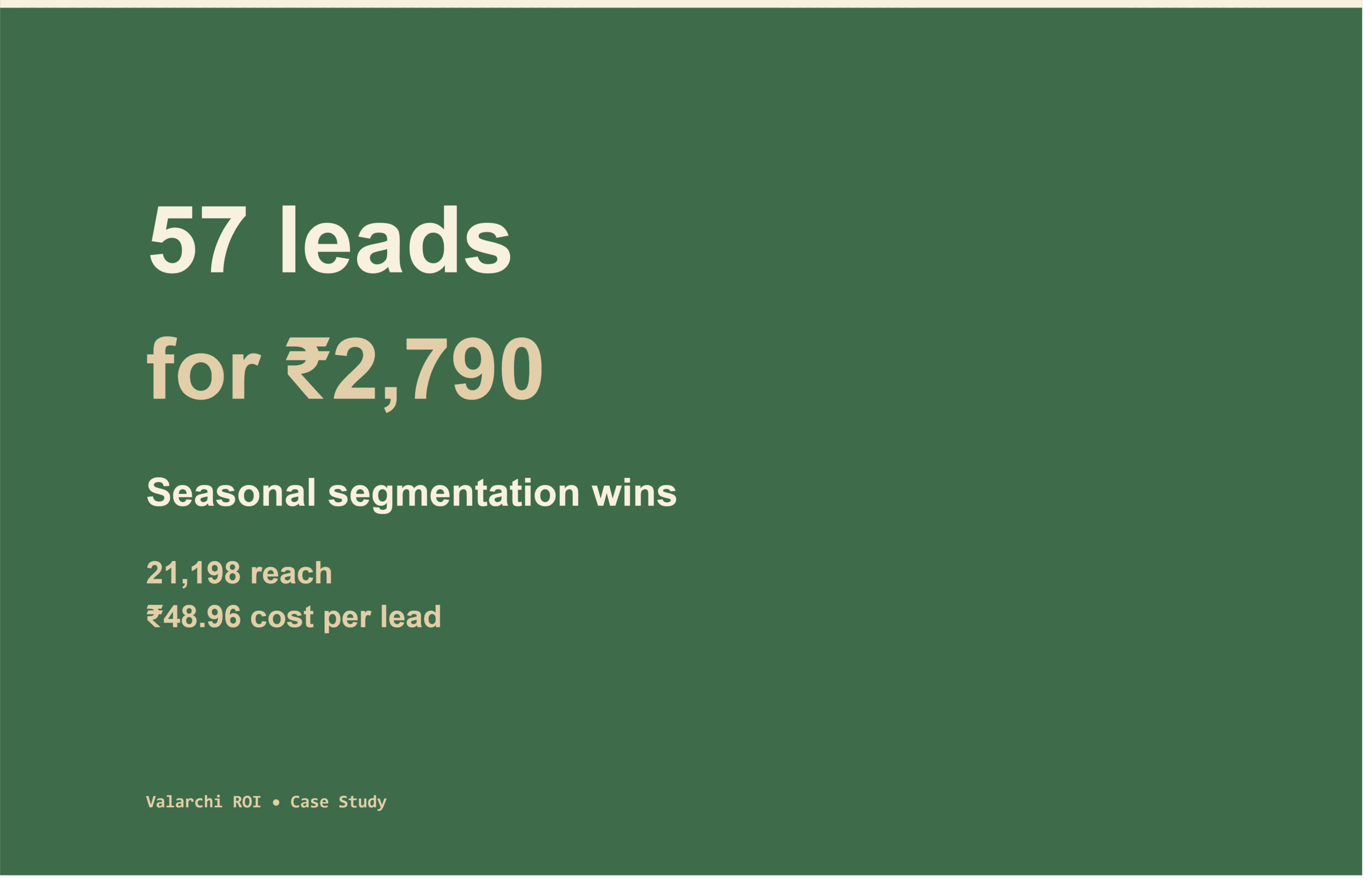
57 leads. 4 days. ₹2,790. This is what happens when you segment seasonal audiences strategically.
₹2,790.89 spent • 57 leads generated • ₹48.96 cost per lead • 3 audience segments tested
Mother’s Day is a narrow window. One day, one occasion, four days of planning. Brands that win don’t just run ads to “mothers.” They run ads to different types of mothers with different reasons to book.
The context
Our client runs day outings at their resort. For Mother’s Day, they wanted to fill bookings with mothers coming to celebrate.
Mother’s Day is seasonal, predictable, and high-intent. Mothers aren’t casually browsing. They’re actively looking for plans. The window is tight. The decision happens fast.
The challenge: reach the right type of mother with the right offer at the right moment.
The challenge
One size doesn’t fit mothers. A woman treating herself wants something different than a mother planning a family outing. A woman buying gifts for her mother has different needs than someone planning group activities.
Most brands run one generic “Mother’s Day” ad. That’s inefficient. You’re showing gift ideas to someone who wants pampering. You’re showing group activities to someone planning solo time.
The budget was allocated for the campaign. No room for waste. Every rupee had to count.
The approach
We created three separate campaigns, each targeting a different type of mother:
1. Moms who treat themselves — Self-care focused. Spa, pampering, personal relaxation. Messaging emphasized “you deserve this.”
2. Family outings — Group activities. Multi-generational bonding. Messaging emphasized togetherness, activities for everyone, fun for kids too.
3. Gift givers — Women buying experiences for their mothers. Messaging emphasized gifting, special treatment for mom, creating memories.
Each segment got distinct creative and messaging tailored to their motivation.
The campaign ran for 4 days (May 6-9, 2026) — right in the Mother’s Day planning window.
The results
| Segment | Spend | Leads | CPL | Reach | Notes |
|---|---|---|---|---|---|
| Moms who treat themselves | ₹644.34 | 8 | ₹80.54 | 4,618 | Self-care focus |
| Family outings | ₹1,747.25 | 41 | ₹42.62 | 13,091 | Most efficient |
| Gift givers | ₹399.30 | 8 | ₹49.91 | 4,980 | Gift experience angle |
| Total | ₹2,790.89 | 57 | ₹48.96 | 21,198 | — |
57 leads from 21,198 reach. Average CPL of ₹48.96.
“Family outings” dominated. 41 out of 57 leads (72%) came from this segment. CPL of ₹42.62 was the most efficient. Why? Because family outings during Mother’s Day hit differently. Mothers don’t want to be alone. They want to bring their kids, their families. They want shared experiences.
That insight drove the segment performance.
“Moms who treat themselves” and “Gift givers” each got 8 leads, but with higher CPLs (₹80.54 and ₹49.91). Still profitable, but less resonant than the family angle.
The lesson
Seasonal occasions aren’t audience segments. They’re motivation shifts.
On Mother’s Day, a mother isn’t just “a mother.” She’s a woman making a specific decision. What she wants depends on why she’s deciding to book.
Segmenting by motivation (not just demographics) is what converts efficiently. Family outings resonated because it matched what mothers actually wanted: time together, not time alone.
Limited budgets force you to be smart about segmentation. You can’t afford to show self-care messaging to gift-givers or group activity messaging to women treating themselves. You have to be precise.
The 4-day window meant urgency worked in our favor. Mothers were already planning. We just had to reach them with the right angle.
Want results like this?
We run Meta Ads for hospitality and events businesses. If you have seasonal or occasion-based campaigns coming up, let’s plan a strategy that reaches people at their moment of decision. See more case studies at valarchiroi.com.